

The Next Generation of Building Heating Has Arrived
The conversation around low-carbon heating is changing.
For many years, organisations focused on replacing one heating system with another. Today, housing providers, NHS estates, universities and commercial property owners are increasingly asking a different question:
“How can we make our buildings intelligent enough to heat themselves only when needed?”
As energy prices continue to fluctuate and Net Zero targets become more demanding, building owners require more than efficient heating. They need real-time information about how buildings are used, how energy is consumed and where improvements can be made.
This is where the combination of NexGen’s low-voltage infrared heating technology and the EyeSense intelligent control platform offers a different approach to building performance.
Why Heating Control Matters More Than Ever
Heating is typically one of the largest operational costs within buildings.
However, many buildings still operate heating systems using:
- Fixed time schedules
- Manual thermostats
- Limited zoning
- Little understanding of actual occupancy
The result is familiar:
- Heating empty rooms
- Overheated spaces
- Inconsistent comfort
- Higher energy bills
- Increased carbon emissions
The future of building management lies in matching heating demand with how buildings are actually used.
What Is Occupancy-Based Heating?
Occupancy-based heating uses real-time information about whether a room or space is being used to automatically adjust heating levels.
Rather than heating an entire building continuously, the system can respond to actual occupancy.
EyeSense has been developed as an AI-driven, distributed energy management system that autonomously manages heating while also monitoring environmental conditions including occupancy, temperature, humidity, CO₂ and solar gain. It can operate alongside existing Building Management Systems or independently, providing estates teams with real-time insight into building performance.
This approach enables heating to become responsive instead of simply following pre-programmed schedules.
The Benefits of Occupancy-Based Heating
For organisations managing large property portfolios, occupancy-led control can provide significant operational advantages.
These include:
- Heating rooms only when occupied
- Reducing unnecessary energy use
- Improving occupant comfort
- Lowering operational costs
- Supporting carbon reduction strategies
- Creating more consistent internal environments
Rather than relying on assumptions about building usage, facilities managers can base heating decisions on measured data.
Data-Driven Energy Management
Modern buildings generate valuable information every second.
Historically, much of this data has gone unused.
EyeSense has been designed to transform environmental information into practical building intelligence.
The platform continuously monitors factors including:
- Occupancy
- Indoor temperature
- Relative humidity
- Carbon dioxide (CO₂)
- Solar gain
- Energy consumption
- Thermal behaviour
According to EyeSense, the platform uses this information to optimise heating, ventilation, lighting and humidity while characterising a building’s thermal performance and supporting data-driven retrofit decisions.
This moves building management from reactive operation towards continuous optimisation.
Building Performance Analytics
One of the biggest challenges facing estate managers is understanding how buildings actually perform after a retrofit.
Traditional energy projects often rely on predicted performance.
Building performance analytics provide real-world evidence instead.
By analysing environmental and operational data over time, organisations can identify:
- Underperforming spaces
- High energy consumption areas
- Occupancy patterns
- Temperature stability
- Humidity trends
- Opportunities for further optimisation
Instead of simply knowing how much energy a building uses, facilities teams can understand why it uses that energy.
Real-World Evidence
The practical value of intelligent energy management is already being demonstrated in operational buildings.
As part of its Carbon Net Zero by 2035 programme, Wadham College at the University of Oxford has installed around 500 EyeSense devices across its estate.
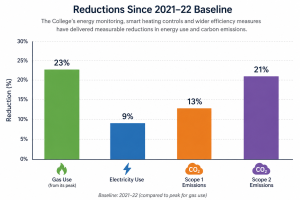
The College reports that the system monitors energy usage in real time and automatically controls heating based on occupancy and comfort data. Together with wider efficiency measures, these installations have contributed to measurable reductions in energy consumption and carbon emissions. Since its 2021–22 baseline, the College reports approximately:
- 23% reduction in gas use from its peak
- 9% reduction in electricity use
- 13% reduction in Scope 1 emissions
- 21% reduction in Scope 2 emissions
Wadham also notes that the EyeSense project has received national recognition through sustainability and retrofit awards.
These results illustrate how intelligent controls can support wider decarbonisation programmes when combined with other building improvements. See the case study here for further information and video.
Combining NexGen Infrared Heating with Intelligent Controls
Heating technology and heating controls should not be viewed as separate systems.
Their greatest value comes when they operate together.
NexGen’s low-voltage infrared heating products are designed to provide responsive radiant heating for:
- Social housing
- NHS estates
- Schools and universities
- Commercial offices
- Care homes
- Public buildings
When integrated with the EyeSense platform, the heating system can respond to measured occupancy and environmental conditions rather than fixed schedules alone. See further information on the EyeSense control system here.
Potential benefits include:
- Reduced heating of unoccupied spaces
- Improved temperature consistency
- Better environmental visibility
- More informed energy management
- Enhanced occupant comfort
This creates a heating solution that is not only efficient but increasingly intelligent.
Supporting Better Asset Management
Estate managers are under increasing pressure to demonstrate:
- Energy savings
- Carbon reductions
- Building performance
- Occupant wellbeing
- Value for money
Building analytics provide evidence that supports these objectives.
Rather than relying solely on utility bills, organisations can begin to understand how individual rooms, zones and buildings perform over time.
This supports better investment decisions and helps identify where further retrofit activity will deliver the greatest benefit.
The SAP Scoring Process – An Update from NexGen
The Standard Assessment Procedure (SAP) is the UK Government’s methodology for assessing the energy performance of dwellings and underpins Energy Performance Certificates (EPCs). It provides a standardised way of evaluating a home’s energy efficiency and carbon performance. SAP 10.3 is the current approved methodology while the future Home Energy Model is being prepared for introduction.
NexGen is currently working with the Building Research Establishment (BRE) on a SAP assessment programme to evaluate the performance of its heating technology within the SAP framework.
The purpose of this work is to obtain independently assessed performance data that can support housing providers, developers and specifiers when evaluating low-carbon heating options.
At the time of writing, the assessment programme and report is ongoing.
Subject to completion of the testing process, NexGen expects further information and SAP-related performance data to become available during November 2026.
Once published, this information is expected to provide customers with additional independently assessed evidence to support product evaluation and specification.
The Future Is Intelligent Heating
Heating systems are becoming part of a much broader building performance ecosystem.
The next generation of buildings will not simply consume less energy.
They will:
- Monitor occupancy automatically.
- Optimise heating continuously.
- Analyse environmental conditions.
- Generate actionable performance data.
- Support long-term decarbonisation strategies.
By combining efficient infrared heating with intelligent environmental monitoring and occupancy-based control, NexGen aims to help organisations move beyond traditional heating systems towards smarter, data-driven building management.
For housing providers, this can support warmer, more efficient homes.
For universities, NHS trusts and commercial estates, it offers greater visibility of building performance.
And for organisations planning their journey to Net Zero, it provides a foundation for making evidence-based decisions that improve comfort, reduce waste and optimise energy use over the long term.